Language

Language




Many foreigners who start driving in Japan are puzzled by “unwritten etiquette” that other drivers follow as a matter of course, even though it is not taught at driving school. Expressing thanks with hazard lights and yielding at merges are uniquely Japanese customs that are not written into law. If you do not know them, they can lead to misunderstandings or trouble, and many people feel uneasy. Simply learning these signals of thanks and yielding etiquette in advance can make driving on Japanese roads much easier.
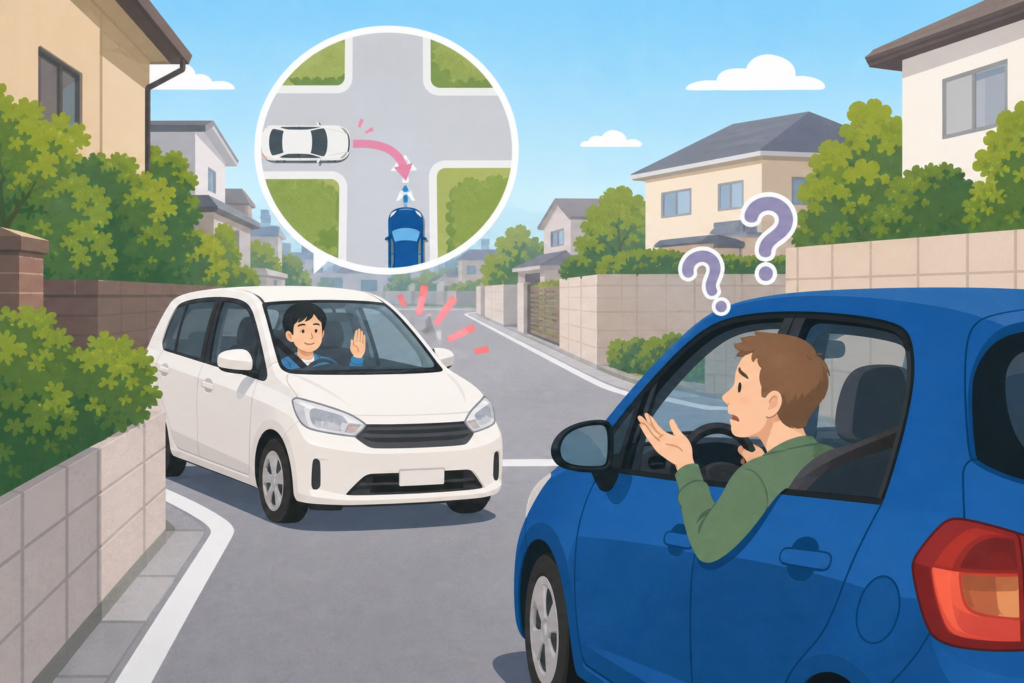
Driving in Japan includes shared customs of “yielding” that many drivers follow even though they are not written into law. These customs are especially evident on narrow residential streets and at highway merge points.
These are not things learned from a textbook; rather, you gradually pick them up by watching how other cars move. Because they are not taught as formal rules, people who have just arrived from overseas may find it difficult to understand why drivers behave that way.
Behind this are Japan’s road conditions—where many vehicles pass through limited road width—and a culture that values consideration for others. By yielding little by little to each other, drivers have handled situations smoothly that signs and signals alone cannot fully cover.
With etiquette that is not codified, many people only realize “What is this?” when they encounter it in a real situation. Here are some situations that commonly cause confusion:
All of these situations become much less confusing once you know what they mean. In other words, simply having prior knowledge can greatly ease the tension of driving on Japanese roads. Noticing differences from your home country’s driving habits is also helpful for avoiding unexpected trouble. In the next section, we will review representative etiquette rules one by one.
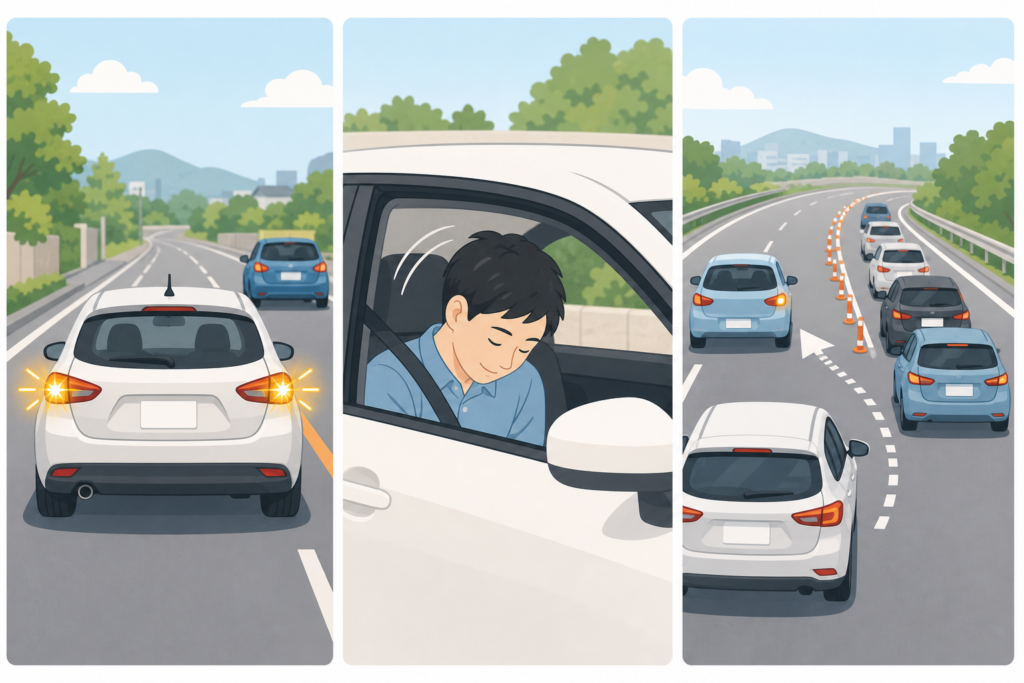
In Japan, there is a custom of flashing your hazard lights a few times to express thanks when someone lets you go. This signal is often used right after being allowed to merge. It is also called “thank-you hazard lights,” and it is widely used among professional drivers who drive daily, such as truck and taxi drivers.
A short 2–3 flashes are sufficient to express thanks.Knowing this meaning helps you avoid mistaking the flashing lights of the car ahead for a breakdown.
Japanese drivers may give a slight bow from inside the car or raise a hand to show thanks or apology. This is often seen when someone waits for you on a narrow road or lets you into a lane.
Even though drivers cannot exchange words between cars, they communicate their feelings through these small gestures. At first, you may feel they are unnecessary, but simply raising your hand lightly can leave a positive impression.
While driving, it is difficult to see each other’s faces, and voices do not carry. That is why visible gestures play a role in preventing unnecessary misunderstandings and friction. Especially right after someone yields to you, clearly conveying your gratitude helps the other driver continue driving in a good mood.
On highways and where lanes reduce, the basic approach is a “zipper merge,” where cars enter alternately one by one at the merge point. Like the teeth of a zipper interlocking, cars from the left and right flow in turn.
If you keep the order in mind, you will be less likely to hesitate at the moment of merging. Zipper merges are also considered effective for reducing congestion, and in recent years they have been promoted through road signs and other means. Because forcing your way in or yielding excessively can disrupt the flow, aim to merge alternately at a steady rhythm.
If you do not know unwritten etiquette, you may be misunderstood by others even without bad intentions. Japanese drivers operate on the assumption of mutual yielding, so falling out of that rhythm can easily create friction.
These risks can be greatly reduced simply by knowing what the etiquette means. If you understand what other drivers expect, you can avoid actions that invite unnecessary misunderstandings. In many cases, whether or not you give a small signal can significantly affect the impression you leave.
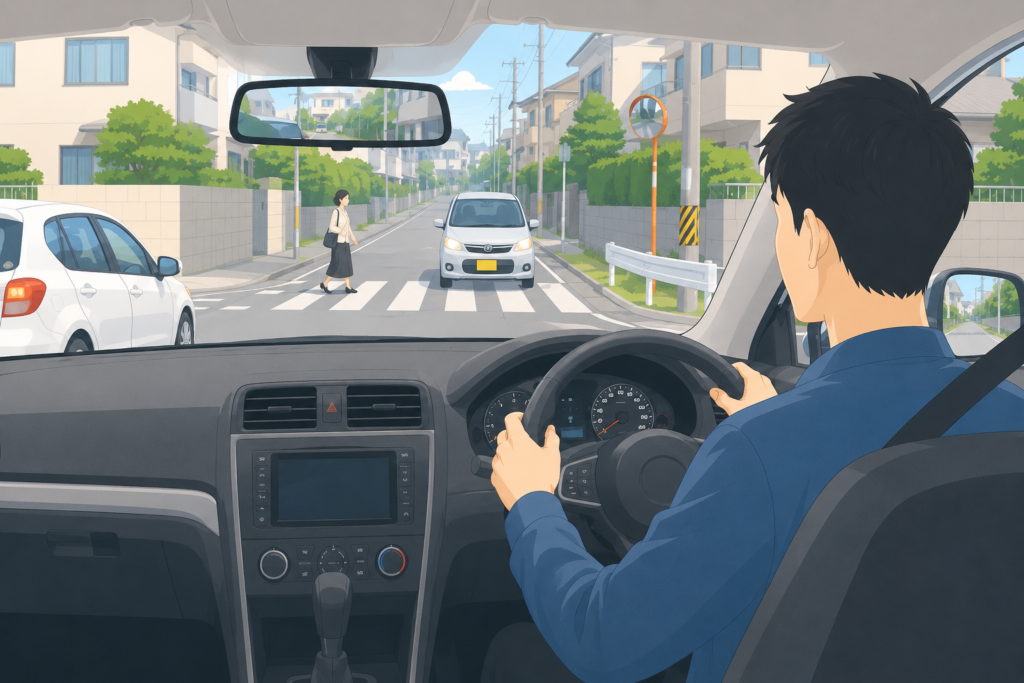
Misunderstandings are most likely at merges, crosswalks, and narrow roads—situations that require judgment about yielding. Because these require split-second decisions, they can be especially stressful until you become accustomed to them.
At merges, be mindful of the zipper-merge order, and at crosswalks, always wait for pedestrians. On narrow roads, carefully watch the other driver’s movement and calmly decide whether to wait or proceed. Rather than moving in a hurry, a willingness to wait briefly leads to safer outcomes.
In addition, in these situations, surrounding drivers are often watching what a foreign driver will do. If you are unsure, do not force a move; communicating your intent with hazard lights or a slight bow makes it easier for others to respond. If you are not yet confident in your judgment, another option is to choose routes that avoid busy times and complex intersections.
If you would like to learn Japanese driving etiquette in a structured way, attending a driving school is the quickest route. The process from enrollment to graduation generally proceeds as follows:
By learning step by step, you can acquire unwritten etiquette along with driving skills. At driving school, instructors provide advice while assuming real situations, making it easier to develop the right feel than studying on your own. Another advantage unique to driving school is that you can ask questions on the spot whenever something is unclear.
It is natural to learn etiquette by observing your surroundings during daily driving. By watching when the car ahead uses hazard lights and where drivers yield, you will gradually develop a sense for it.
It is also important not to rush and to allow enough following distance and time. Without a sense of urgency, you can make calmer decisions about whether to yield. If you consciously observe what signals the cars in front of and behind you are giving while waiting at lights or in traffic, it becomes easier to understand the meaning of unwritten etiquette in a practical way.
Once you become more comfortable, trying thank-you hazard lights or a slight bow yourself can make interactions with others smoother. Even if you cannot imitate it well at first, your body will begin to respond naturally as you drive repeatedly, so take it one step at a time without rushing.
Japan License Connect is a media platform that supports foreigners in obtaining a driver’s license. Its key feature is that it provides information focused on points that are easy to get stuck on due to language and system differences.
Because you can learn not only about obtaining a license but also about Japan’s road conditions and etiquette, you can prepare while easing anxiety soon after arriving in Japan. Even if you have driving experience in your home country, checking Japan-specific rules and customs in advance will help you start driving smoothly.
For more details, please visit Japan License Connect.
Japanese roads include many yielding customs that are not written into law. Thank-you hazard lights, zipper merges, and giving priority to pedestrians at crosswalks are all things you can handle without confusion once you know what they mean.
These customs will come naturally as you observe surrounding vehicles and drive without rushing, leaving yourself enough margin. Not knowing something is never embarrassing; it is enough to learn them one by one.
If you would like to learn more about obtaining a license and Japanese driving etiquette, please continue checking Japan License Connect for updates. Even if you are unsure how to choose a driving school, you are sure to find a learning environment that suits you. Let us prepare step by step so you can enjoy driving in Japan with confidence.
Japan License Connect is a media platform that supports foreigners in obtaining a driver’s license in multiple languages, including English, Chinese, and Vietnamese. In addition to searching for and comparing driving schools and residential driver training camps that support foreign languages, it also clearly explains the steps for converting a foreign driver’s license to a Japanese license.
If you are unsure about unwritten driving etiquette or how to choose a driving school, start by gathering the information you need—at your own pace.
 関連記事
関連記事 Feel free to contact us with any questions.
 For individuals