Language

Language


To use a driver’s license obtained abroad in Japan, it is important to correctly understand the “Foreign License Conversion” system and smoothly complete the necessary procedures and exams. In this article, we will provide an easy-to-understand explanation of the key points for starting to drive safely in Japan, organizing everything from the basics of the system to the procedural flow, preparation for knowledge and skill exams,
and common questions.
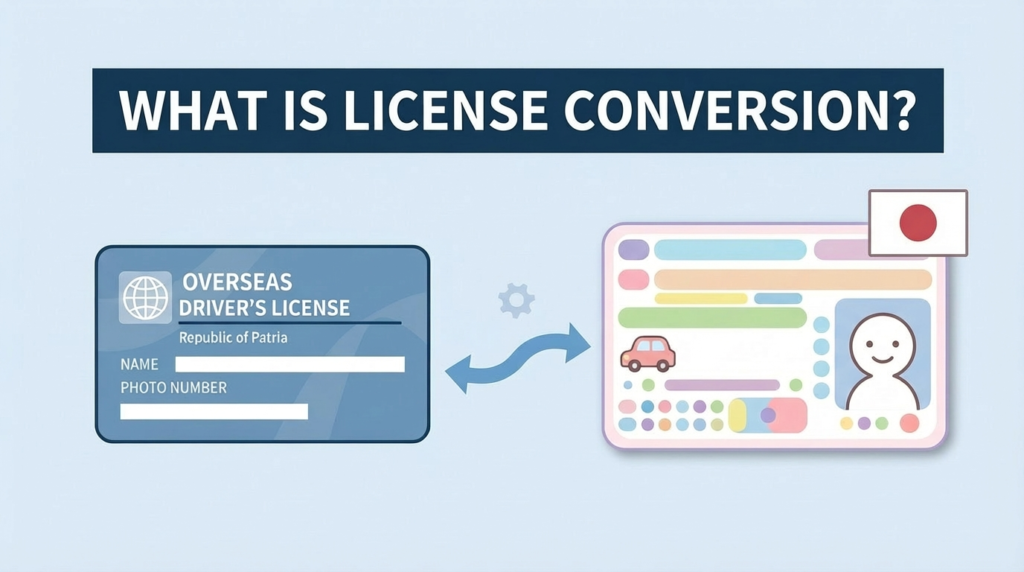
The foreign license conversion system is a mechanism for converting a license obtained in a foreign country into a Japanese license. To maintain a balance with traffic safety, this system plays a role in ensuring that drivers acquire Japanese rules and manners through examinations.
Procedures and the requirement for exams vary depending on the country where the license was obtained. Particularly important items to check include the following:
*Conditions are subject to change, so please check the latest information at a driver’s license center in advance.
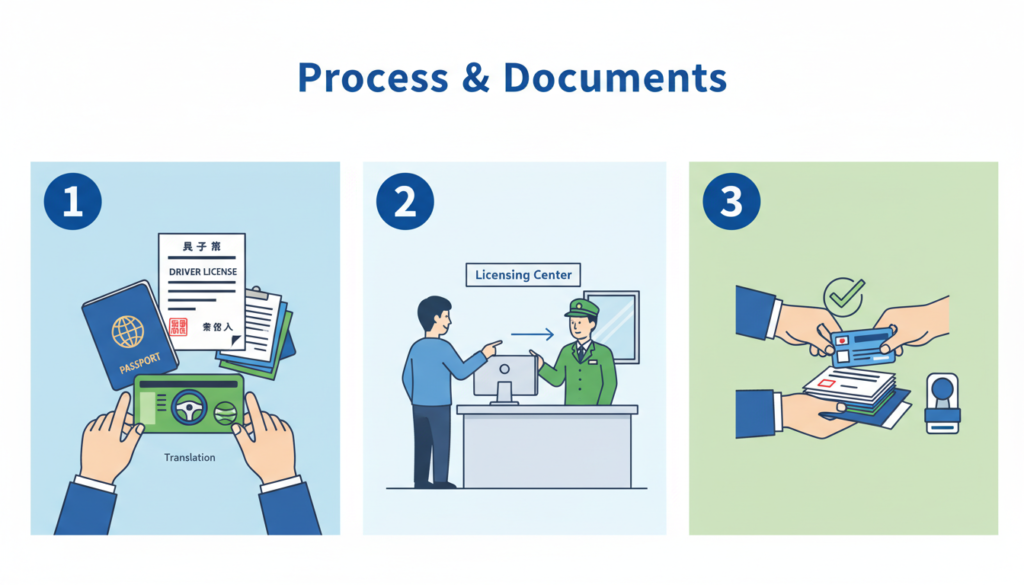
Since the procedure may take several days, it is important to manage your schedule with plenty of time to spare. The general flow is as follows:
Document requirements vary slightly by region, so be sure to check in advance. The main required documents are as follows:
In addition to checking for incomplete documentation, the following conditions are strictly reviewed:
・Verification of Residency Status: Whether your address registration and residency status in Japan are appropriate will be confirmed.
・Proof of Stay: You must prove that you stayed in the country of issuance for a total of 3 months or more after obtaining the license.
・License Validity: The foreign license must be valid at the time of the conversion application.
The knowledge check exam determines whether you correctly understand Japanese traffic rules and road signs. The main topics covered are as follows:
The exam mainly consists of True/False and multiple-choice questions. While the content is generally intuitive, it is easy to make mistakes based on “assumptions” due to differences from rules in your home country, so caution is required.
To avoid unnecessary retakes, keep the following two points in mind during your preparation:
The skill exam evaluates whether you can correctly practice safety checks based on Japanese traffic rules. Rather than “smoothness of driving,” a “safety-first approach” is strongly required.
Main Evaluation Points:
The passing grade is based on a demerit system, but “serious violations” such as ignoring signals, failing to stop, or obstructing pedestrians will result in immediate termination of the exam (failure).
For the exam, you must set aside your “personal driving style” and internalize “driving that is evaluated,” which clearly communicates your actions to the examiner.
We have summarized the most common questions and answers for those considering foreign license conversion.
Time Required for Completion: The time it takes to convert varies greatly depending on the country of issuance, exam congestion, and document preparation. If there are no issues with the documents and you pass the exam on the first try, it can be completed in a short period. However, if there are long waits for reservations or multiple retakes, it can take several months. It is important to proceed with plenty of time in your schedule.
Conditions and Cautions for Conversion: It is not the case that “anyone with a foreign license can convert unconditionally.” The following points are strictly checked:
Authenticity: If the license is suspected of being forged or judged to have been obtained improperly, the procedure cannot proceed. Cases where someone targets a specific country to obtain a license solely for conversion are strictly scrutinized. Additionally, if the license has already expired or forgery is suspected, you may not be able to start the process at all.
Proof of Stay: You must have stayed in the country of issuance for at least 3 months in total after obtaining the license. “Short-term acquisition for the purpose of conversion” is not permitted.
Validity Period: The foreign license must be valid at the time of the conversion application.
For those who have obtained a driver’s license abroad, anxiety about procedures and exams can be greatly reduced by organizing information in advance and preparing according to your situation. The key is to focus on Japan’s unique rules and signs for the knowledge check exam, and to master thorough safety checks and a Japanese-style driving sense for the skill exam.
 関連記事
関連記事 Feel free to contact us with any questions.
  For individuals