Language

Language


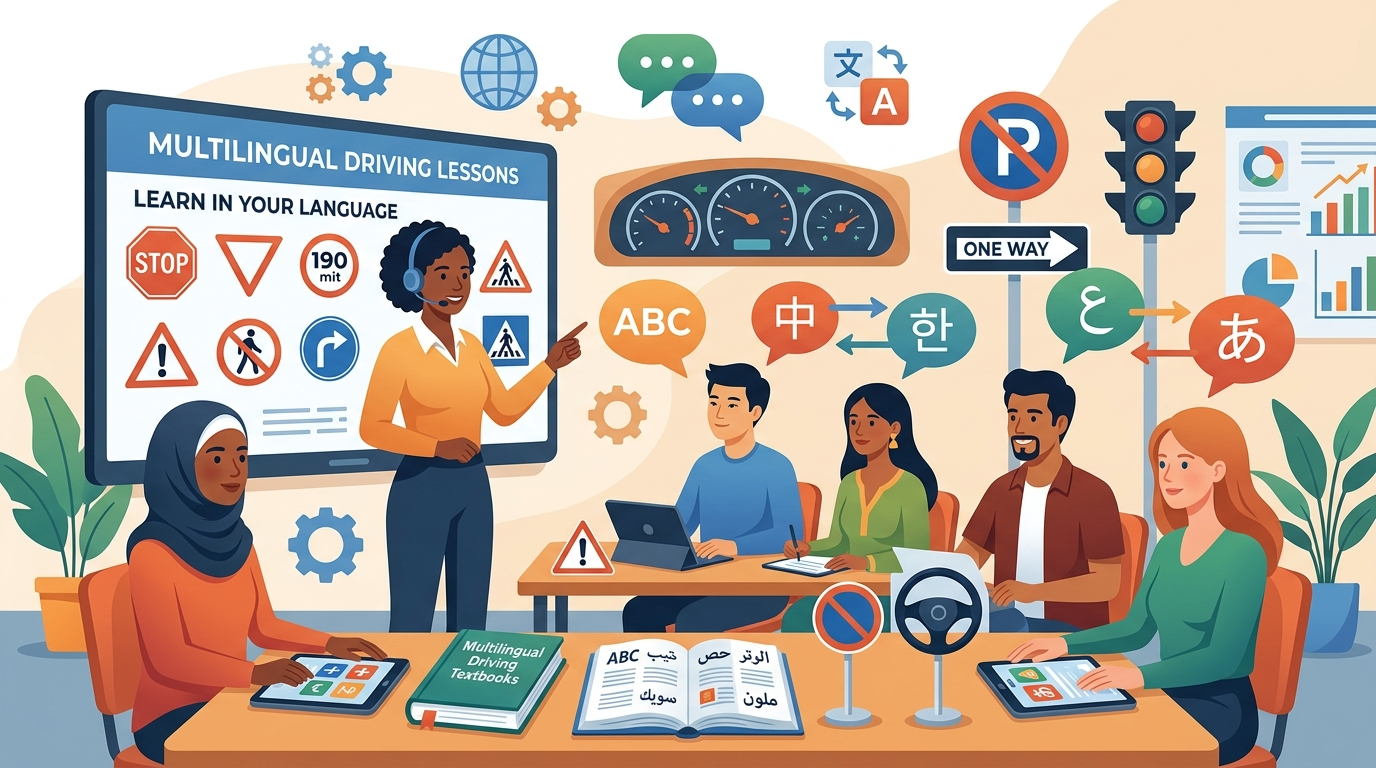
As the number of foreign nationals working or living in Japan increases, the number of people who need to drive cars or trucks is also steadily rising. Particularly in fields such as logistics, construction, and manufacturing, driving is often a prerequisite for employment, leading to a growing demand for driving schools as venues for obtaining, renewing, or changing license classifications.
On the other hand, multilingual support in driving schools varies greatly by region. Aside from a few languages like English and Chinese, there are many cases where support is insufficient. When academic materials and guidance documents are only in Japanese, or when oral explanations are primarily in Japanese, foreign students may proceed with only a vague understanding. This presents a significant risk, not only regarding pass rates for academic exams but also from the perspective of establishing safe driving habits.
In the future, it is expected that the utilization of foreign human resources will further progress in various industries, including tourism, manufacturing, and logistics. In this context, the extent to which driving schools can establish multilingual support is becoming a theme that affects both regional safety and industrial competitiveness.
Looking at driving schools across Japan, the progress of multilingual support varies considerably. In metropolitan areas or regions with many foreign residents, some driving schools provide materials and guidance in English and Chinese. In some cases, multilingual staff members are on-site, creating an environment where reception and simple explanations can be handled in foreign languages.
Conversely, small and medium-sized driving schools in rural areas often lack sufficient multilingual materials or are forced to rely on interpreters. In some cases, information provision is limited to the bare minimum, utilizing multilingual pamphlets created by the government.
Regarding the system, there are regions where parts of the academic exam can be taken in multiple languages, but there are often restrictions on dates and supported languages, meaning students cannot always take the exam at their preferred timing. Furthermore, if the academic and practical training materials or methods independently prepared by the driving school are not multilingual, the learning process may not keep pace even if the exam itself is available in multiple languages.
Thus, it can be said that the current situation is that many driving schools “want to provide multilingual support, but human resources and material preparation cannot keep up.”
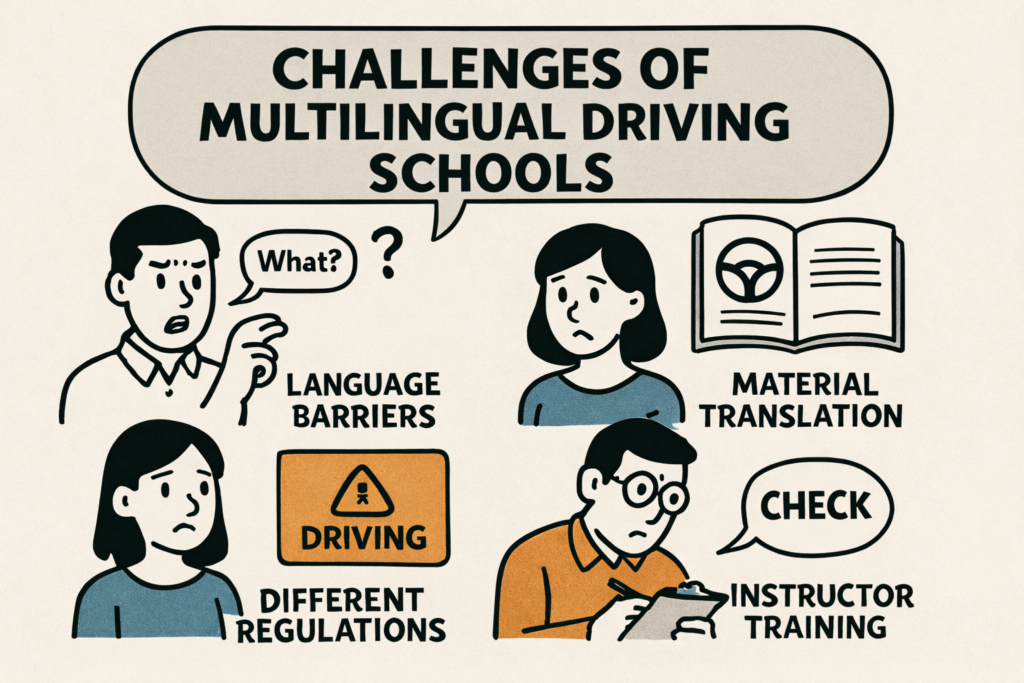
The core of multilingual support in driving schools lies in academic and practical training. It is essential for students to accurately understand traffic rules, signs, and safety confirmation methods. If a language gap occurs here, it leads to risks directly related to safety as well as the quality of learning.
Academic training involves many technical terms and abstract concepts. Expressions such as “slow down,” “no entry,” and “intersection with poor visibility” can be difficult even in Japanese, making them feel even more challenging for students who do not fully understand the language. Even if instructors provide supplementary oral explanations, students may fail to keep up due to differences in language proficiency, often overlooking crucial points.
In practical training, instantaneous understanding is required when instructors give directions inside the vehicle. If instructions such as “turn left at the next intersection” or “please stop once before proceeding” are not communicated, it could lead to dangerous maneuvers. Particularly in situations requiring split-second judgment, such as emergency avoidance or hazard prediction, the language barrier can become a major risk factor.
For this reason, multilingual support must be viewed not just as a means to “pass the exam,” but as a prerequisite for “acquiring safe driving skills.” Essentially, the goal is to create a state where one can drive safely, and the question is how far the language gap can be bridged to achieve that.
For driving schools wishing to advance multilingual support, the burden of interpretation and translation is a major issue. Since languages may differ for each student, attempting to accommodate all of them can exceed the resources available on-site.
On the other hand, if multilingual materials, apps, and videos are prepared, it is possible to reduce dependency on interpretation to some extent. However, decisions on how to recover that initial investment and which languages to provide are unavoidable. If too much is spent on interpretation and translation, it may be reflected in tuition fees, increasing the burden on students.

In recent years, training utilizing multilingual materials and learning apps has been on the rise. Beyond simply translating paper materials into various languages, there is a growing movement to improve comprehension of academic content by providing materials in various formats, such as videos, audio, and quiz formats.
Using multilingual apps allows students to learn repeatedly at their own pace and review difficult sections as many times as needed. From the driving school’s perspective, this has the advantage of improving the quality of home study in addition to classroom time. In particular, combining this with content that uses many signs and illustrations makes it easier for students with limited Japanese proficiency to visualize the concepts.
A characteristic of successful driving schools is that they do not simply replace the language, but identify “which parts are easy to stumble on” and focus their multilingual efforts there. By preparing multilingual materials centered on high-priority units, frequent exam themes, and content directly related to safety, they achieve effective support even with limited resources.
Multilingual support does not necessarily mean switching everything to a foreign language. Since many foreign nationals live in Japan while learning the language, a realistic and effective approach is to use “Easy Japanese” as a base while incorporating native language support at key points.
By combining “Easy Japanese” with native language support, students can study Japanese while ensuring they grasp the knowledge necessary for safe driving. Especially for those who drive for work, such as truck or bus drivers, the ability to understand signs, markings, and instructions in Japanese is essential. In that sense, it is important to design training with a focus on “bridging Japanese and the native language” rather than excluding Japanese entirely.
In advancing this approach, it is helpful for instructors to receive training in using “Easy Japanese” and to organize and share phrases that frequently occur on-site. Efforts to lower the difficulty of language lead to training that is easy to understand not only for multilingual support but also for Japanese students, thereby contributing to the quality improvement of the driving school as a whole.
From this perspective, it is realistic to first prioritize the preparation of 2 to 3 languages and prepare materials, guidance texts, and basic phrase collections. When choosing supported languages, it is important to look at both “current needs” and “future prospects.” For example, even if there are few students at present, if a local logistics company plans to increase hiring from a specific country, it is worth preparing support for that language in advance.
Multilingual support in driving schools is becoming an important foundation that supports Japan’s traffic safety and industry, rather than just a service improvement. With the increase in foreign drivers, the utilization of the Specified Skilled Worker system, and the expansion of international licenses and foreign license conversions, a training and education system that transcends language barriers is required to match environmental changes.
On the ground, there are many challenges such as interpretation and translation costs, staff language proficiency, and coordination with the government. However, progress can be made step-by-step through practical innovations such as the use of “Easy Japanese” and native language support, multilingual materials and apps, and collaboration with companies.The starting point for considering multilingual support is to redefine the goal of training not just as “obtaining a license,” but as “fostering drivers who can continue to work safely.”
If driving schools, companies, and the foreign drivers themselves can create a system to learn from and support each other from their respective positions, Japan’s roads will become safer, and the sustainability of industries such as logistics will increase. Advancing multilingual support in driving schools step-by-step can be called a solid investment in that future.
 関連記事
関連記事 Feel free to contact us with any questions.
  For individuals