Language

Language




Many people want to drive in Japan but feel unsure, thinking, “I don’t really understand how the foreign license conversion process works,” or “I’m worried about where to go and what to do.” In this article, we will organize the requirements, necessary documents, and the day-of process for switching from a foreign driver’s license to a Japanese driver’s license as simply as possible. We will also explain common points of confusion for people from various countries such as Vietnam, China, Indonesia, and Nepal, so please read along while comparing it with your own situation.
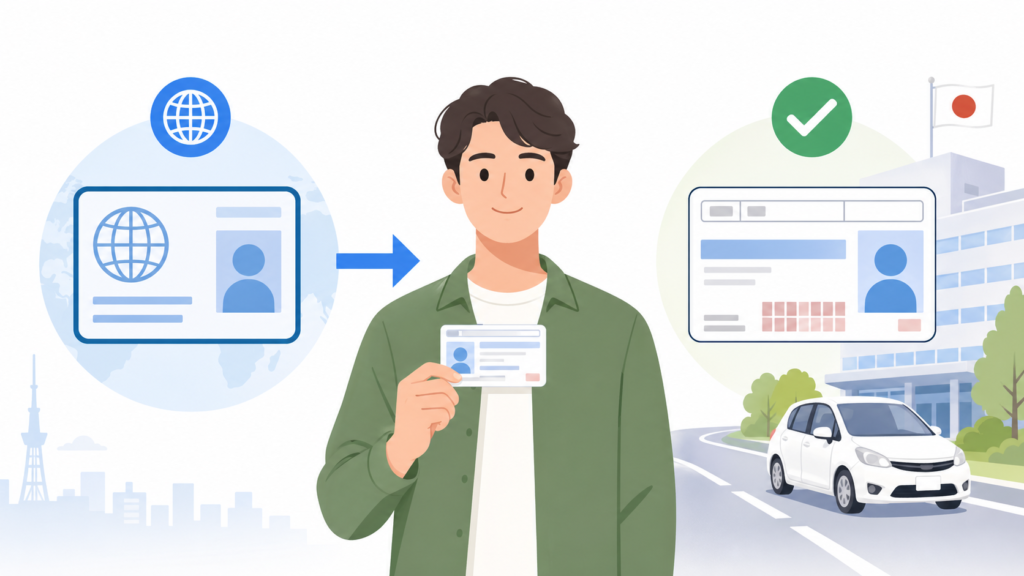
Foreign license conversion is the procedure for obtaining a Japanese driver’s license based on a driver’s license acquired in a country or region outside Japan. Rather than obtaining a license from scratch at a Japanese driving school or testing center, it is easier to understand it as a system that converts an already valid foreign license you hold into the right to drive in Japan.
In principle, it applies to people who hold a driver’s license from a country or region that is eligible for conversion in Japan and who have stayed in that country or region for a certain period of time or longer. In many cases, an important point is “having stayed in that country for at least three months and having obtained and used the license there.” In addition, to proceed with the procedure in Japan, you will be required to submit documents related to your residency status and identity verification.
On the other hand, in some cases it may be difficult to apply for conversion with only a foreign license if you are staying for a short period for tourism purposes or if the license has expired. First, it is important to organize “which country your license is from” and “how long you were in that country when you obtained it.”
The flow for switching from a foreign license to a Japanese license differs slightly by prefecture, but the basic steps are the same. Knowing the overall picture makes it easier to prepare specifically.
First, confirm with the driver’s license center or testing site that has jurisdiction over your place of residence whether the conversion procedure is possible. Then, gather the required documents (foreign driver’s license, translation, residence card, photo, etc.) and apply at the counter. During the application, you may also be asked a few simple questions about your license and stay history.
After that, you will be guided through an aptitude test, written test, and driving skills test, among others. What is required depends on your country/region of origin and the type of license. However, depending on your country/region of origin, some or all of the written and/or skills tests may be waived. Finally, you pay the issuance fee and receive your Japanese driver’s license. Confirming as early as possible which tests you need to take is important when planning your schedule.
*As procedures and whether tests are required may change depending on the region and timing, please check the latest information with each driver’s license center.
The first thing to confirm is whether “your foreign license is eligible for conversion in Japan.” If your license is not treated as eligible for conversion in Japan, you may need to obtain a new license within Japan rather than using the foreign license conversion process. Also, even within the same country, handling may differ depending on the license category (standard car, motorcycle, heavy vehicle, etc.).
Another major condition is “the length of your stay in that foreign country.” Generally, it is said that you must have stayed in the country or region where you obtained the license for a total of at least three months. This is a condition to confirm that you did not simply obtain the license and immediately return to Japan, but that you have gained a certain amount of driving experience in that country. Since you will need to prove your stay period with passport entry/exit stamps, certificates of residence, and similar documents, it is important to keep supporting documents carefully even before returning to Japan.
In foreign license conversion, depending on the country or region, parts of the written test and/or driving skills test may be waived. Whether a waiver applies and its scope are determined based on Japanese standards, and vary depending on your country/region of origin and the conditions of your license.
However, it is not as simple as “this country is always exempt” or “this region always requires tests.” Whether a waiver applies and its scope are determined based on standards set by Japan’s National Police Agency. In addition, the system may be reviewed, so information from a few years ago may not necessarily still be valid today. Ultimately, it is essential to confirm with the latest guidance from your local driver’s license center or police station. General explanatory articles on the internet can be helpful, but be sure to also check official information.
The conversion procedure requires many documents, and each one has a clear purpose. The core document is your “foreign driver’s license.” This proves that you already have driving qualifications, and it must be valid (not expired).
Next, you will need a “Japanese translation of the license.” This allows the Japanese side to accurately understand what is written on the foreign license (category, date of issue, expiration date, etc.). In addition, your “passport” is needed to confirm when you entered and left each country, while your “residence card” and certificate of residence (jūminhyō) serve to show your actual residence in Japan. You will also need to prepare items such as an “ID photo,” “application form,” and “fees.”
With this in mind, it becomes easier to understand why each document is required if you recognize that each document serves to prove “driving qualifications,” “length of stay,” and “residence in Japan”. Once you understand the roles, it will also be easier to imagine what kinds of deficiencies could stop the procedure.
When preparing documents, it is important not only to “gather them,” but also to ensure “the contents are accurate.” In particular, translations and residence cards can be areas where people often stumble over small details, so please pay attention to the following points.
The format of the translation and how the requesting organization is handled vary by country and region. If the translation method or the conditions for required documents do not match, your application may not be accepted at the counter, so it is important to check the official guidance from the driver’s license center or relevant organizations before applying.
If you can picture the specific flow in advance, your anxiety on the day will be greatly reduced. Depending on the region, you may need a reservation, or you may go directly to the counter, but the common steps are as follows.
In addition to these documents, it is also reassuring to confirm items to bring on the day such as writing utensils and memo paper for filling out forms, as well as cash depending on how fees are paid.
Since the aptitude test includes an eyesight test, if you use glasses or contact lenses, be sure to bring them with you.
The written test covers Japanese traffic rules, road signs, and safe driving principles. Depending on your country/region of origin, it may be waived, but those who need to take it may feel uneasy about questions being in Japanese. Even in that case, if you study in advance using the materials and practice question books introduced in official guidance, it will be easier to get used to the question patterns. In particular, it is important to focus on rules emphasized in Japan, such as the meaning of road signs, how priority roads work, and the prohibition of drunk driving.
The test is scheduled, and if you are late, you may not be able to take it that day. In addition to reception hours, confirm the test start time and the approximate end time in advance, and arrive at the venue with plenty of time to spare.
In the driving skills test, you will actually drive a car while your understanding of Japanese driving rules is assessed. In many cases, it is conducted on a course within the testing facility, with an examiner riding in the passenger seat. Before the test, you may be given a course map and an explanation, so it is important to listen calmly to the instructions.
Common stumbling points include “driving on the left,” “where to stop at stop signs,” “strictly prioritizing pedestrians,” and “the timing of signals and mirror checks.” In particular, Japan places a very strong emphasis on the safety of pedestrians and cyclists, and examiners look closely at yielding to pedestrians at crosswalks and slowing down and checking carefully at intersections without traffic signals. Beyond maneuvers such as reversing and parallel parking, a key evaluation point is how carefully you check your surroundings for safety.
The procedure for switching from a foreign license to a Japanese license involves many considerations—country-specific requirements, document preparation, and dealing with Japanese tests—so you may feel confused at first. However, if you organize the overall flow and required conditions one by one, you will be able to see what you need to prepare. In particular, understanding “which tests are required” and “what each document proves” is a major point in reducing anxiety.
To drive safely in Japan, it is essential not only to obtain a license, but also to maintain an attitude of continuously learning Japan-specific traffic rules, road signs, and everyday driving manners. Even if you are not yet comfortable with Japanese, by making good use of multilingual support and training environments designed for foreign residents, you can move forward at your own pace.
If you would like more detailed information about obtaining or converting a license, or if you want to find a driving school or training camp plan that suits you, please also refer to the information from Japan License Connect. By using articles that support your understanding of the system and help you choose a driving school, take the first step toward a safe and comfortable driving life in Japan.
 関連記事
関連記事 Feel free to contact us with any questions.
 For individuals