Language

Language


For foreigners driving in Japan, understanding traffic signs is essential for safe driving and obtaining a license. In particular, Japanese text on signs like ‘Stop’ (止まれ) and ‘Slow Down’ (徐行), as well as auxiliary signs indicating times, days, and vehicle categories, are common points of misunderstanding.
In this article, we have selected the top 20 Japanese traffic signs that foreigners often struggle with, providing clear explanations of their meanings and how to distinguish them. Please use this as a resource for written exam preparation and for checking before you actually drive.
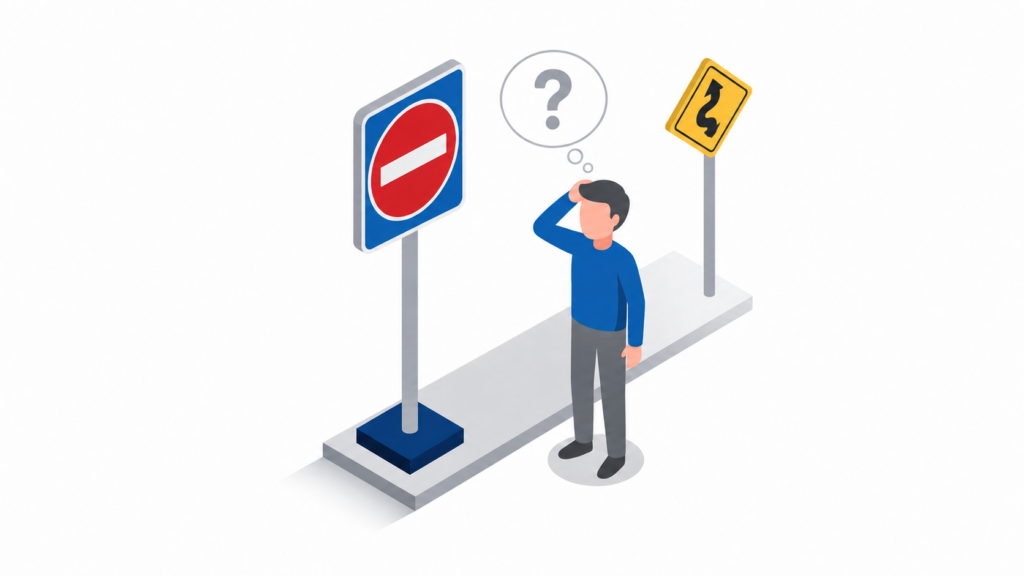
Japanese traffic signs require you to check not only shapes and colors but also Japanese characters and detailed conditions.
Because of this, foreigners may feel that a sign ‘looks similar to one I’ve seen before, but the meaning is different.’
To drive safely in Japan, it is important to understand not just the meaning of the signs, but also how you should act on the road.
There are three main reasons why Japanese traffic signs can be confusing.
For example, the ‘Stop’ sign is difficult to judge immediately if you cannot read Japanese.
To start, it is helpful to categorize and learn them by their roles, such as ‘Regulatory Signs,’ ‘Warning Signs,’ ‘Instructional Signs,’ and ‘Guide Signs.’
Traffic signs are most easily misunderstood in situations where judgment is required in a short amount of time.
Examples include narrow roads in residential areas, in front of stations, at intersections, or when looking for a parking spot.
If you are looking at a navigation system while also watching for pedestrians, you may overlook signs.
Particular caution is needed for ‘One Way’ and ‘No Parking or Stopping’ signs.
Being conscious of spotting signs early can help reduce panic.
Japanese road signs are broadly divided into four types: Guide Signs, Warning Signs, Regulatory Signs, and Instructional Signs. Additionally, there are ‘Auxiliary Signs’ that supplement the meaning of the main signs.
The order in which to look at them is color and shape, then marks or text, and finally auxiliary signs.
Checking in this order makes it easier to stay calm and make judgments even on unfamiliar roads.
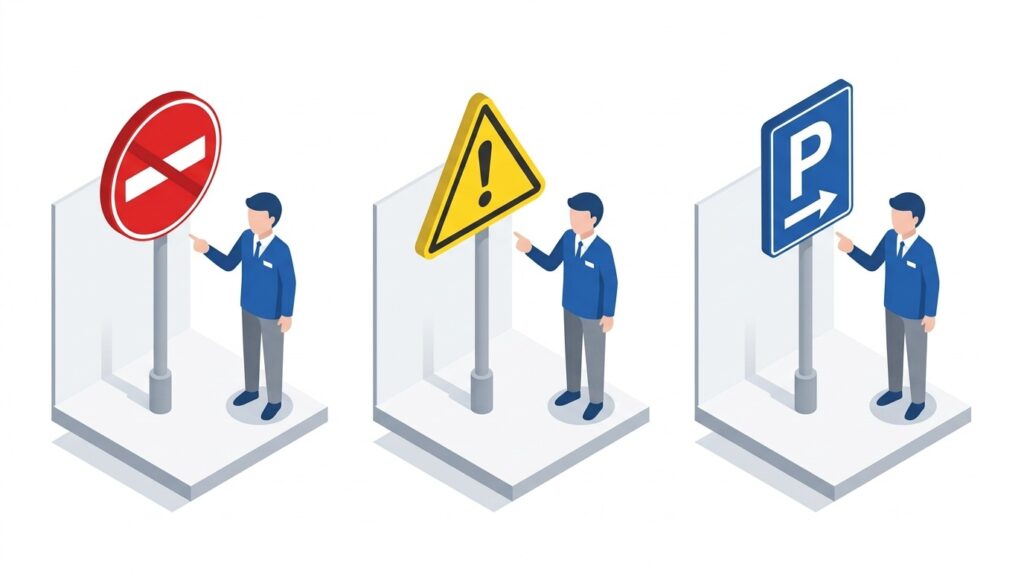
Japanese traffic signs have different roles depending on their type.
Knowing the basic way to view them beforehand will make you less likely to get lost while driving.
It is safer to check ‘what you must not do’ before ‘what you are allowed to do.’
Regulatory signs indicate prohibitions or restrictions, such as ‘No Entry’ or ‘No Parking.’
Instructional signs indicate methods or locations for passage, such as ‘Crosswalk’ or ‘Bicycles Only.’
Warning signs alert you to hazards ahead, such as curves or railroad crossings.
Common mistakes include the following three:
It is best to learn the meanings of each type separately.
Auxiliary signs are small signs attached below the main sign. They indicate times, days of the week, vehicle types, or specific zones.
For example, if it says ‘8-20,’ the rule applies during those hours. If it says ‘Except Sundays and Holidays,’ you must also check the day of the week.
Developing the habit of looking at auxiliary signs will reduce misunderstandings.
In Japan, there are signs written in Japanese, such as ‘Stop’ (止まれ) and ‘Slow Down’ (徐行).
Since there is little time to read while driving, it is safer to memorize their meanings in advance.
Words to be particularly careful of include:
Even if the Japanese is a bit difficult, you will be fine if you start by learning the most common words.
Learning while checking a list of signs on your smartphone makes it easier to understand even in a short time.
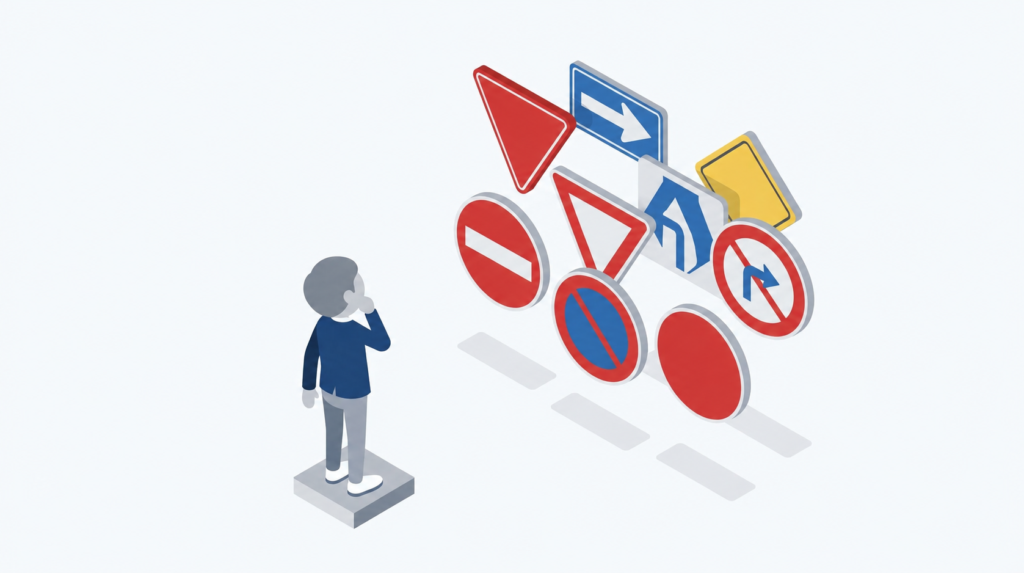
Here, we introduce 20 traffic signs that foreigners often find confusing when driving in Japan.
Be careful, as some signs may look similar but have different meanings.
The important thing is to be able to judge whether to ‘stop, not proceed, or be cautious’ the moment you see the sign.
Prohibitory signs indicate places you must not enter or roads you cannot pass through.
Signs that are easy to struggle with include:
A common mistake is seeing a red sign and proceeding, thinking it just means ‘caution.’
It is safer to remember that red circles or red diagonal lines mean prohibition.
Directional signs indicate the directions in which you can proceed.
Overlooking these at intersections or narrow roads can lead to driving the wrong way or traffic violations.
Signs that are easy to struggle with include:
A common failure is trusting only the navigation system and not looking at the signs.
Before turning, check for blue arrows or red prohibition symbols.
Parking signs are important for determining whether you can stop your vehicle.
Thinking ‘it’s okay for just a moment’ can lead to obstructing traffic.
Signs that are easy to struggle with include:
A common mistake is thinking ‘No Parking’ and ‘No Parking or Stopping’ mean the same thing.
In ‘No Parking or Stopping’ zones, you must be careful even about stopping for a very short time.
Safety confirmation signs are very important for preventing accidents.
In areas with many pedestrians or bicycles, early confirmation is especially necessary.
Signs that are easy to struggle with include:
A common mistake is proceeding because you cannot read the ‘Stop’ (止まれ) sign.
If you are worried about Japanese, it is safer to memorize the characters and the shape of the sign as a set.
It might seem like there are a lot of traffic signs.
However, they are easier to understand if you learn them in groups of meanings.
Rather than rote memorization, it is safer to learn signs by ‘what to do when you see that sign.’
When learning signs, it is important not to memorize them by shape alone.
Learn them in combination with actions, such as ‘Stop,’ ‘Do not enter,’ or ‘Do not turn.’
Here are tips for memorizing:
A common mistake is trying to learn similar signs all at once and getting confused.
Even just 10 minutes a day, it is easier to continue if you check them by meaning.
In the written exam, you will be asked not only the names of the signs but also their meanings.
Therefore, it is important to practice reading the question and thinking ‘which action is correct.’
Points to check include:
A common mistake is answering by looking only at the main sign.
If you practice reading down to the auxiliary signs, you can make calm judgments.
On actual roads, there are many things to look at besides signs.
Because you are checking pedestrians, bicycles, signals, and navigation all at once, it is easy to overlook things.
Here are ways to reduce oversights:
On unfamiliar roads, just slowing down a little makes it easier to check.
It is safer to develop a habit of looking without rushing.
To obtain a driver’s license in Japan, understanding traffic rules and signs is essential.
Understanding the meaning of signs will make you feel more secure not only during the written exam but also during actual driving.
It is important to check the signs that are easy to struggle with before aiming to get your license.
Traffic signs are necessary for both the written exam and actual driving.
If you do not understand the meanings correctly, you may get lost when solving problems or driving on the road.
Points to check in particular include:
Learning signs as a set with ‘actions’ rather than just ‘appearance’ will help with both exam preparation and driving.
When looking for a driving school that supports foreign languages, it is important not to decide based on language alone.
Also check the ease of commuting and the support provided.
Points to check include:
Choosing a specific driving school in a hurry may result in conditions that do not suit you.
Comparing multiple pieces of information will make it easier to make a choice that fits you.
Some Japanese traffic signs are similar to those overseas, but their meanings and rules may differ.
Auxiliary signs and Japanese text, in particular, are points where foreigners often struggle.
By understanding the traffic signs introduced here in advance, you can reduce anxiety not only for written exam preparation but also during actual driving.
Correctly understanding the meaning of traffic signs is the first step toward safe driving.
It is important to move forward with preparation while checking official institutions and reliable information rather than leaving things unclear. Since systems and procedures are subject to change, please check the latest information from each prefectural police department before applying.
In addition to understanding traffic signs and rules, finding a driving school that suits you is an important point for proceeding with license acquisition with peace of mind. If you want to know about the process of obtaining a license or information on foreign-language-friendly driving schools, please continue to check Japan License Connect.
 関連記事
関連記事 Feel free to contact us with any questions.
 For individuals