Is Getting a Driver’s License in Japan Really That Difficult? Challenges Faced by Foreigners and Solutions
When considering obtaining a driver’s license in Japan, many people search for “Japan license difficult.” Concerns arise from various factors: Japanese language barriers, differences from home country regulations, and complex procedures. In most cases, anxiety grows because it is unclear “what exactly makes it difficult.” This article provides a clear explanation of the characteristics of Japan’s licensing system and common stumbling blocks, while offering specific strategies and guidance on gathering information.
1. Understanding Whether Getting a Driver’s License in Japan Is Really Difficult
1.1 Main Reasons and Background for Perceiving “Japan License Difficult”
Foreigners perceive obtaining a driver’s license in Japan as “difficult” not because of the strictness of the system itself, but because three barriers—language, system, and culture—overlap.
Japanese language comprehension: Written tests include reading comprehension and specialized terminology
Japan-specific traffic rules: Pedestrian priority, narrow roads, school zones, etc.
Complex procedures: Multiple stages of appointments and document preparation at licensing centers
Understanding these barriers in advance and preparing accordingly leads to a smoother licensing process.
1.2 Basic Structure of Japan’s Driver’s License System and Types of Tests
Japan’s driver’s license system is a step-by-step mechanism combining learning at driving schools with examinations at testing centers.
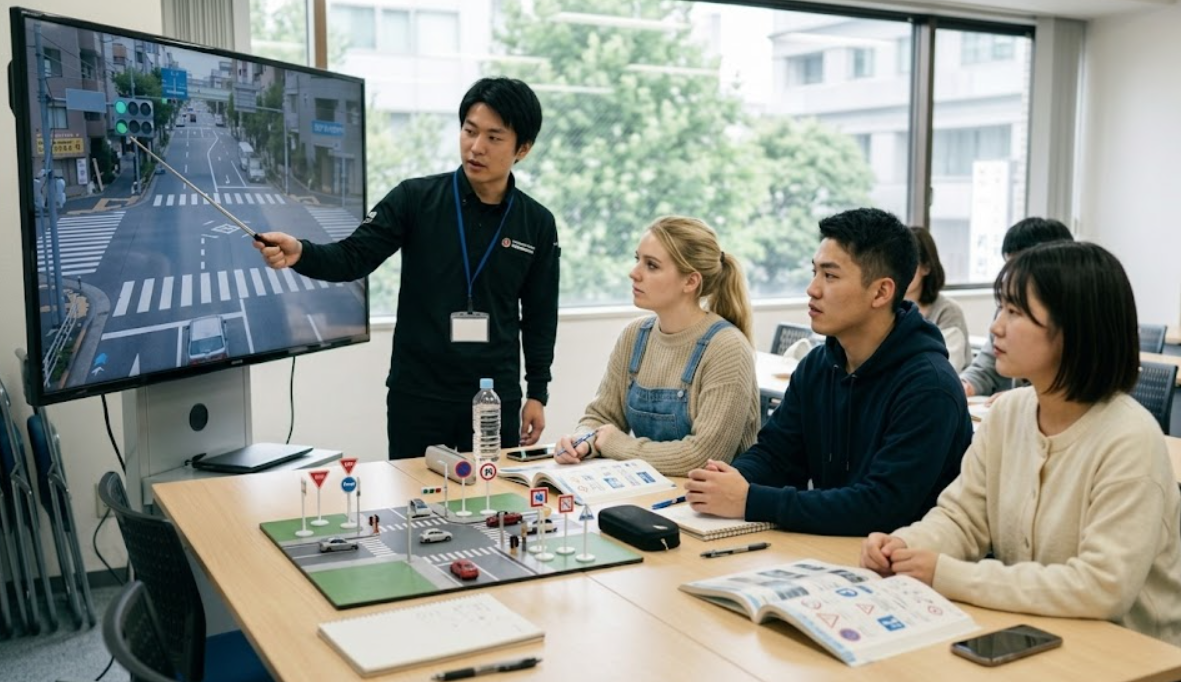
Learning at driving schools: Complete required hours of classroom and practical instruction, pass on-site and on-road tests, and pass the provisional license written exam
Post-graduation examination: License is issued upon passing the written test at the driver’s license examination center
License categories: Regular, moped, motorcycle, large vehicle, etc., with different instruction content and test requirements
Direct examination: Possible to take the test directly at the examination center without attending driving school, but with higher difficulty
This step-by-step structure ensures thorough acquisition of driving skills and understanding of traffic rules.
1.3 The “Difficult” Gap Arising from Differences with Home Countries
Many foreigners find obtaining a driver’s license in Japan difficult due to gaps with their home country’s licensing systems.
Detailed requirements for instruction hours and classroom learning can feel burdensome to those from countries where licenses can be obtained quickly
Emphasis on safety confirmation and hazard prediction, with evaluation of attitude including visual checks, signals, and pedestrian consideration
“Accident prevention mindset” is more important than “driving skill”
Understanding differences in systems and values and preparing accordingly makes test requirements clearer.
2. Points Where Foreigners Often Find Japanese License Acquisition Difficult
2.1 Specific Situations Where Japanese Written Tests Feel Difficult
The challenge in Japanese written tests lies in the need for understanding not just vocabulary but sentences and terminology.
Sentences with negations and double negatives such as “must not” and “may”
Similar terms with different meanings such as “slow down,” “overtake,” and “pass”
Questions requiring memorization of traffic sign names and meanings together
Long questions with legal-style expressions
Questions containing specialized terms rarely used in daily conversation
The key to passing is not just vocabulary but becoming familiar with how to read questions and their patterns.
2.2 Japan-Specific Rules That Cause Confusion in Practical Training and Skill Tests
What confuses foreigners in practical training and skill tests is the many things “that must be done”.
Strict pedestrian priority: Deceleration and safety confirmation near crosswalks
Slowing down and confirming at signal changes and when turning right or left
Evaluation of speed, steering, and even eye movement in tasks such as S-curves, crank turns, hill starts, and parallel parking
Sequence for lane changes: Mirror → visual check → signal → reconfirmation
Even with driving experience from home countries, practicing Japanese-style confirmation and manners is key to passing.
3. Study Methods and Preparation for Overcoming Written Tests
3.1 Understanding Question Format and Passing Standards for Foreign Applicants
For written test preparation, understanding the question format and passing standards is essential.
Multiple-choice format: Primarily true/false and four-choice questions
Number of questions and time limits vary by prefecture
Foreign language support: Available in English, Chinese, etc., in some regions
Passing scores are strictly set even for simplified versions
To score well across road signs, traffic rules, and safe driving knowledge, familiarizing yourself with the format through past questions and practice apps provides reassurance.
3.2 Written Test Strategies and Study Tips for Those Concerned About Japanese
Even without confidence in Japanese, you can approach the written test with the right strategies.
Prioritize frequently appearing Japanese expressions: Memorize terms like “slow down,” “temporary stop,” and “entry prohibited” with their meanings using flashcards
Learn with diagrams and illustrations: Connect signs and markings with images and meanings for retention
Familiarize yourself with patterns through practice questions: Repeatedly practice question formats and common traps
Read aloud and explain: Speaking regulations and rules aloud helps understand Japanese rhythm
Focusing on Japanese necessary for the test allows you to efficiently improve your score.
4. Key Points to Avoid Failure in Practical Training and Skill Tests
4.1 Safety Confirmation and Driving Manners Emphasized in Japanese Road Training
In Japanese road training, “cautious driving with consideration for surroundings” is most emphasized.
Safety confirmation before starting: Check mirrors and visually confirm presence of pedestrians and bicycles
Caution when turning right or left: Early signaling and deceleration, consideration for crosswalks and bicycles
Handling narrow roads: Prioritize oncoming vehicles and pedestrians, stop beforehand if necessary
Lane changes and merging: Follow the sequence of turn signal, mirror, visual check
Rather than performing actions “formally,” understanding why they are necessary and applying them to driving directly connects to Japanese-style safe driving.
4.2 Main Deduction Points Checked by Examiners and Countermeasures
In skill tests, accumulation of minor mistakes leads to failure. Common deduction points include:
Insufficient safety confirmation: Inadequate mirror and visual checks when starting, changing lanes, turning, or entering intersections
Speed control errors: Exceeding speed limits or insufficient deceleration before curves or intersections
Insufficient consideration for crosswalks and pedestrians: Inadequate deceleration and confirmation regardless of pedestrian presence
Signal timing and operation errors: Forgetting turn signals or timing discrepancies
Practicing with awareness of these points clarifies examiner evaluation criteria and enables calm driving.
5. Choosing Driving Schools and Acquisition Methods for Smooth License Acquisition in Japan
5.1 Differences Between Intensive Camp Licenses and Commuter Licenses and How to Choose in Japan
Methods for obtaining a license in Japan include intensive camp licenses and commuter licenses.
Intensive camp license: Stay at a driving school in a regional area for a set period and receive concentrated instruction in a short time. Schedule is predetermined, requiring minimal self-scheduling.
Commuter license: Attend a driving school near home or work and learn according to your own schedule. Suitable for balancing with work or school.
For foreigners, the availability of Japanese language support and multilingual services is also an important selection criterion. Choosing between camp or commuter based on living environment and Japanese proficiency enables efficient learning.
5.2 How Difficulty and Process Differ Between Foreign License Conversion and New Acquisition
If you already hold a driver’s license from your home country, foreign license conversion is available.
Method to convert to a Japanese license based on existing foreign license
If conditions are met, required instruction hours are reduced
Required tests and procedures vary by country and license type
Conversion involves verification of residency period, acquisition date, and driving experience, and may require some or all of written, practical, and aptitude tests. Without a home country license, new acquisition is required, which involves more cost and time but allows learning Japanese traffic rules and manners from the basics. Confirming the appropriate method early is essential.
6. How to Utilize Japan License Connect for Those Seeking a License in Japan
6.1 Why It Suits Those Looking for Multilingual Driving Schools
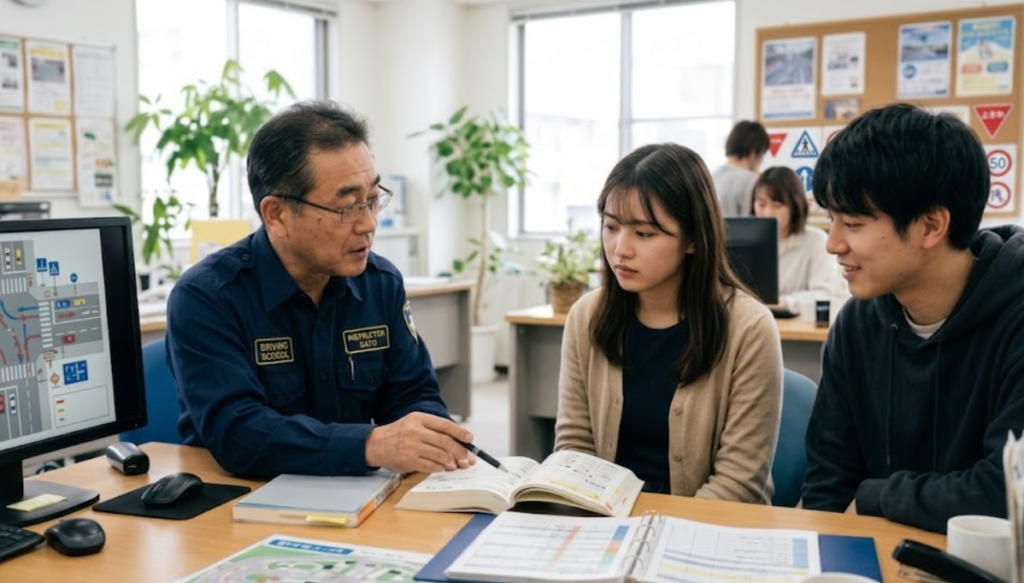
For foreigners aiming to obtain a license in Japan, choosing a driving school is an important first step.
Japan License Connect is a media platform for comparing multilingual driving schools and intensive camp license plans
Support availability can be confirmed for Vietnamese, Chinese, Indonesian, Nepali, and other languages
You can check which aspects—classroom, practical, reception—offer support
Even with concerns about Japanese, being able to confirm supported languages and support content in advance reduces worries during the driving school selection stage and enables confident learning.
6.2 Features Allowing Comprehensive Comparison of Classroom, Practical, and Test Information
Japan License Connect allows comprehensive confirmation not only of driving school information but also of systems and latest information regarding classroom, practical, and tests.
Types of foreign language teaching materials and textbooks
Teaching policies and safety confirmation instruction methods in practical training
Official guides on license tests and foreign license conversion
Latest news on road traffic law revisions and test content
This reduces concerns about “where to look for written test preparation” and “whether systems have changed,” and makes comparing multiple driving schools easier according to your language and objectives.
6.3 Structure Providing Reassurance Even for First-Time License Acquisition in Japan
For foreigners obtaining a license in Japan, organizing information sources is the initial challenge.
Japan License Connect provides not only driving school comparisons but also columns and guides on licensing systems, procedures, and study methods
Comprehensive coverage of Japanese license system basics, foreign license conversion procedures, required documents, written test study methods, and failure examples
Latest information on road traffic laws and test content is updated, reducing risks from outdated information
It can be used as an “information hub” where you can quickly confirm uncertainties without extensive research, streamlining preparation.
7. Use Information Effectively to Resolve Concerns When Aiming for License Acquisition in Japan
While obtaining a driver’s license in Japan can feel “difficult” due to differences in language, systems, and culture, knowing the hurdles in advance enables preparation.
Written test: Familiarize yourself with Japanese expressions and question formats
Practical test: Understand safety confirmation and pedestrian priority concepts
Driving schools and procedures: Confirm multilingual support and assistance systems
To reduce the burden of researching systems and rules alone, utilizing media and materials for foreigners is efficient. By selecting information according to Japanese proficiency and driving experience and preparing step by step, you can transform concerns into confidence.
Japan License Connect provides multilingual driving school information for foreigners seeking to obtain a license in Japan. Information on systems and procedures is also comprehensive to support confident selection.
How to Obtain a Driver's License Smoothly Through Driving School Camps for Foreign Nationals





 関連記事
関連記事 Feel free to contact us with any questions.
 For individuals