Language

Language




If you are not yet confident in Japanese, many people likely feel anxious about whether they can really attend a driving school. In conclusion, there are quite a few driving schools that accept students as long as they can read hiragana and handle simple conversation. In this article, we will clearly and gently organize the approximate Japanese level required at enrollment, the points to check when choosing a driving school, the support you can use, and the process through to obtaining your license. Use this as a guide to reduce language-related anxiety and find a driving school that suits you.

Even if you struggle with Japanese, there are many driving schools that accept enrollment. At many schools, it is often said that you can enroll if you can read hiragana and respond to simple Japanese questions and prompts.
Because you are not expected to have perfect Japanese from the start, there is no need to worry excessively even if you feel uneasy about conversation.
Before enrolling, it is reassuring to confirm with the driving school whether you can proceed smoothly with your current Japanese ability.By checking in advance, you can reduce situations after you start where you feel confused because “the language is harder than I expected.”
While prerequisites at enrollment vary by driving school, there are some basic items that are commonly required. It is a good idea to organize the following points in advance.
These are not special qualifications; they mainly involve Japanese used in everyday life.
Because required documents may differ by school, contacting them before applying will help the process go smoothly.
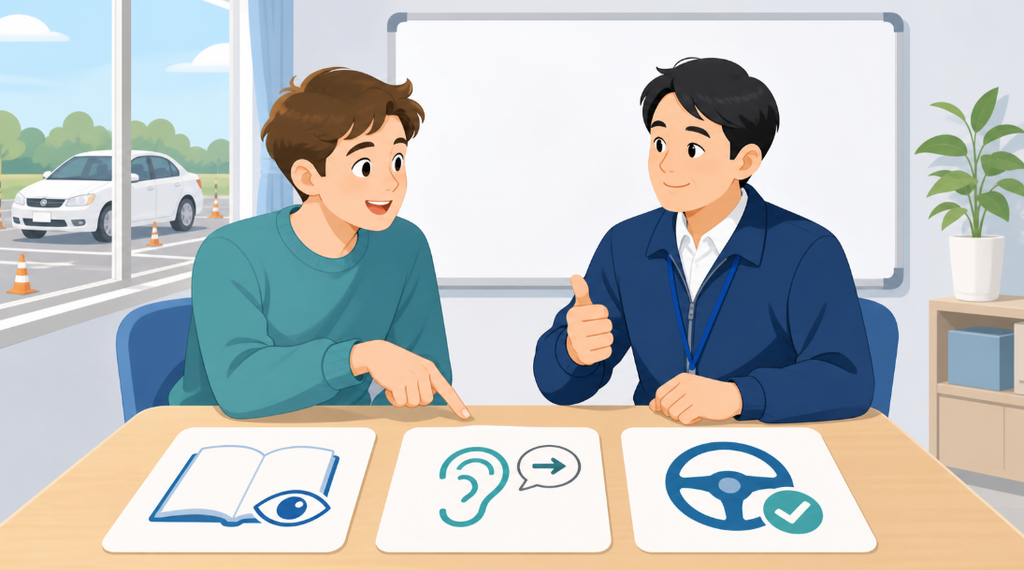
The Japanese proficiency required at a driving school differs slightly depending on the situation. A general guideline is as follows.
| Situation | Japanese mainly used | Guideline |
| Enrollment procedures | Filling out forms and understanding explanations | Able to write your name and address |
| Classroom instruction | Understanding textbooks and videos | Able to read hiragana and katakana |
| Driving lessons | Understanding instructors’ directions | Able to handle simple conversation |
| Various exams | Reading the questions | Able to comprehend written passages |
Some driving schools use Japanese-Language Proficiency Test (JLPT) N3 as a guideline, but standards vary by school.
Even for the same “Japanese ability,” whether reading or listening is more important depends on the situation.If you identify in advance which situations you feel uneasy about, it becomes easier to choose the support you need.
Reading and writing hiragana and katakana are required because being able to read characters is closely tied to understanding textbooks and road signs. Many of the textbooks used in classroom lessons are written in Japanese, and signs and guidance displays also contain written information.
If you cannot read, you will have to rely only on what you hear, which tends to make review difficult.
Reading ability is the foundation that affects how well you understand the training and how easily you can review it.Conversely, even being able to read hiragana alone can significantly reduce the learning burden.
In practical driving lessons, there are many situations where you must respond to an instructor’s directions on the spot, which can make language-related anxiety more likely. Typical situations include the following:
Because sudden directions directly affect vehicle operation, not being able to catch them can easily lead to anxiety.
If you memorize commonly used instruction phrases in advance, you can ease your nerves on the day.

When choosing a driving school, you will want to first confirm supported languages and whether multilingual materials are available. Checking the following points in advance makes comparisons easier:
Some driving schools provide textbooks in English, Chinese, and other languages.
Whether materials are available in a language you understand greatly affects how well you can follow the classroom lessons.
Whether interpreter support or plain Japanese support is available is an important point to confirm in advance. If a driving school allows an interpreter to attend with you, or explains things by rephrasing them in simpler terms, language-related anxiety can be greatly reduced.
On the other hand, not all schools have interpreters available at all times.
Confirming availability and conditions in advance helps prevent mismatches after enrollment.When making an inquiry, asking specifically, “Is it okay even if I struggle with Japanese?” will help you understand what support is actually provided.
Whether you can take the written exam in a foreign language depends on the type of exam and the region. The general trend is as follows:
| Exam | Details | Language support trend |
| Provisional license written exam | Written exam conducted within the driving school | Varies depending on the school’s support |
| Full license written exam | Exam at the driver’s license center | Varies by prefecture |
| Skills Test | Driving skills test | Directions are basically given in Japanese |
More regions are now offering written exams at driver’s license centers in up to 20 languages.
Because available exam languages differ by the license center that has jurisdiction over your address, you must check official information.Supported languages and reservation requirements may change, so it is reassuring to check the latest information early.
If you struggle with Japanese, choosing a driving school with multilingual support is a strong option. At schools with materials in your native language and extensive experience accepting foreign students, explanations tend to be clearer and it is easier to ask for help.
Schools with a proven track record often understand where language-related stumbling points tend to occur.
A school’s experience accepting foreign students is a clue for assessing how robust its support system is.
By using a service that compiles and compares multilingual support information, you can narrow down candidates more efficiently.
By making good use of interpreter services and translation tools, you can further reduce language-related anxiety. Options include the following:
However, whether you can use translation tools during training depends on the school’s rules.
Confirming in advance what is allowed helps prevent issues on the day.Once you know which tools you can use, it also becomes easier to plan your preparation and review.
An environment where you can receive explanations in plain Japanese provides steady support for learning. If instructors avoid difficult technical terms and explain in short, segmented phrases, it becomes easier to understand the content.
When you understand the language, it also becomes easier to ask questions and resolve doubts on the spot.
Clarity of explanations directly affects how smoothly your training progresses.By asking about how explanations are given when you inquire before enrollment, you can get a sense of the atmosphere.
Applying to a driving school generally proceeds step by step from inquiry to enrollment. The basic flow is as follows:
Because required documents may differ by school, confirming in advance is essential.
Since missing documents can delay enrollment, preparing early is reassuring.If you are well prepared, you can complete the procedures calmly on the day.
It is common for classroom lessons and practical driving lessons to proceed in parallel. In classroom lessons, you learn traffic rules, signs, and safe driving knowledge; in practical lessons, you practice actual driving operations step by step.
What you learn in classroom lessons supports your practical lessons, and questions that arise in practical lessons can be addressed in classroom lessons.
Advancing both in a balanced way helps solidify your understanding.Asking questions early and not carrying uncertainties into the next stage is the quickest path to improvement.
To obtain your license, you will pass several exams in stages. The order is as follows:
Each stage has its purpose, and the system is designed to progress step by step.
Passing each one steadily may seem like a detour, but it is the most reliable path.Because you can often retake exams, it is important to approach them without rushing.
The time and cost to obtain a license often differ between commuting and training camps. Training camps are generally an intensive, short-term format, while commuting allows you to attend at your own pace.
Among those considering obtaining a license in a short period, you may also see comments such as the following:
| Online commentWhich driving school is best for getting a license through the shortest possible training camp? One that accepts foreign students.Source: Yahoo! Chiebukuro |
Because costs vary by region, season, and course, it is best to compare multiple schools as a guideline.
In practical terms, it is best to choose based on the balance between time, cost, and your lifestyle.
With Japan License Connect, you can review information that is broadly useful when foreign nationals choose a driving school. We mainly provide the following:
These serve as materials for people who feel uneasy about the language to compare and consider their options.
Being able to compare multiple driving schools from the same perspective reduces the burden of searching for information.
If you find a school that interests you, it becomes easier to take the next step right away.
Japan License Connect is well suited for those who are looking for a driving school while feeling uneasy about the language. It is helpful for people who have concerns such as taking a long time to gather information in Japanese or not knowing which schools support foreign students.
It is also well suited for those who want to compare multiple schools and choose an environment that fits them.
Having information organized in multiple languages supports first-time driving school searches.
If the burden of researching alone is reduced, it should become easier to take the first step toward obtaining your license.
If information is organized in multiple languages, you can also choose candidates while consulting with your family. When you choose a driving school with confidence, the sense of reassurance after you start attending will also be different. Considering options together with those around you leads to a choice you will not regret.
Even if you struggle with Japanese, it is entirely possible to aim to obtain your license through a driving school. Many schools allow enrollment if you can read hiragana and handle simple conversation, and support such as multilingual materials, interpreters, and plain Japanese is also becoming more widespread.
When choosing a driving school, confirming supported languages, materials, whether interpreters are available, and which languages you can take exams in will give you peace of mind. Language-related anxiety can be greatly reduced through advance confirmation and choosing an environment that suits you.
For more detailed information about obtaining a license, please compare driving schools on Japan License Connect and find the one school that is right for you.
 関連記事
関連記事 Feel free to contact us with any questions.
 For individuals