Language

Language



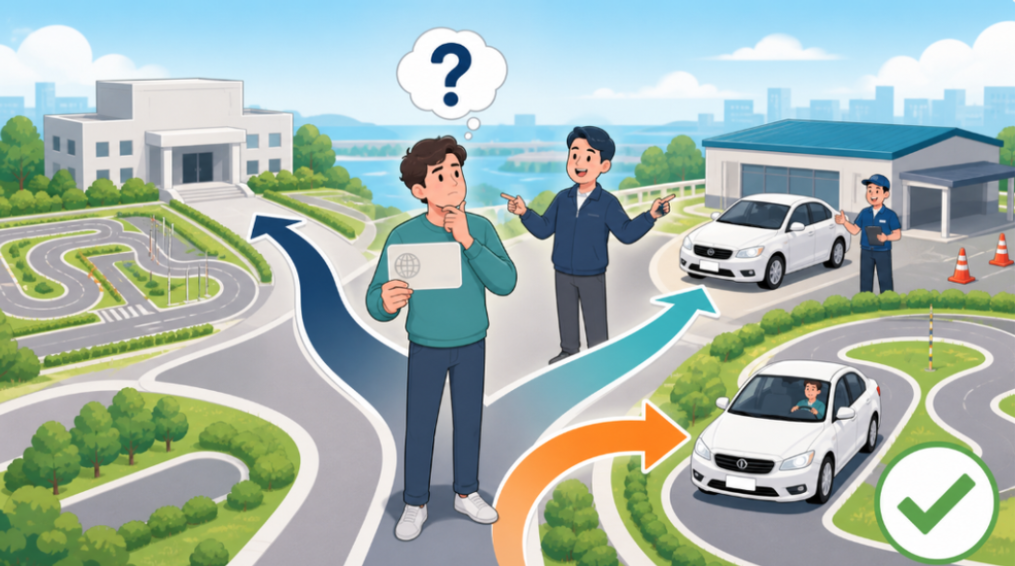
Are you feeling anxious about where to practice ahead of your driving skill check for the Foreign License Conversion? If you face the actual check without the opportunity to get used to Japanese driving rules and scoring criteria, it is easy to become flustered even if you have the skills. This article organizes the types of places where you can practice for the conversion, the driving maneuvers and traffic rules you should practice, and how to prepare. Taking into account the system changes in October 2025, we have summarized the criteria for choosing a practice location that is right for you.
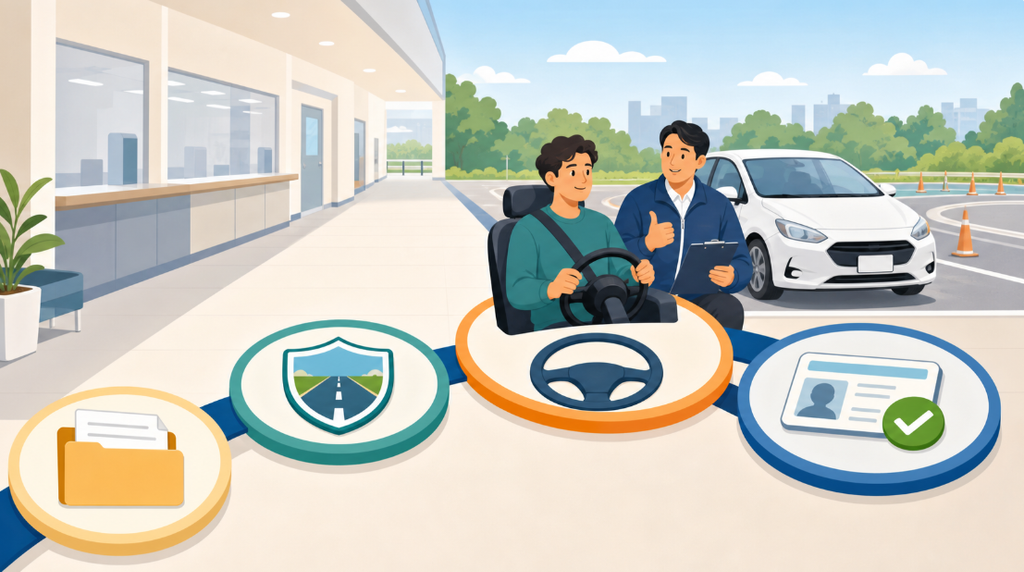
The Foreign License Conversion process is carried out at the driver’s license testing center that has jurisdiction over your place of residence. Broadly speaking, the flow consists of document verification, a knowledge check, and a driving skill check. Practice is mainly relevant during the knowledge check and driving skill check stages.
Licenses from certain countries or regions may be exempt from the driving skill check or knowledge check, and the amount of preparation required changes depending on whether you are eligible for an exemption. First, confirming which flow applies to you will make it easier to create a practice plan.
The table below organizes the flow of the procedure and how practice relates to each stage.
| Stage | Main Content | Role of Practice |
| Document Verification | Verification of license and translation | Focus on checking required items |
| Knowledge Check | Confirming understanding of traffic rules | Prior study determines the result |
| Driving Skill Check | Driving a course in an actual vehicle | On-site driving practice is important |
| License Issuance | Obtaining a Japanese license after passing | Practice not required |
If you are not eligible for an exemption, practicing for both the knowledge check and the driving skill check is the shortcut to passing.
The most common stumbling block in Foreign License Conversion is not driving skill itself, but rather a lack of familiarity with Japan’s unique rules and scoring criteria. Even for those who have driven for a long time in their home country, if the order of safety checks or the timing of signals differs from Japanese standards, it can lead to point deductions.
The following points are common areas of confusion during the driving skill check:
Many driving schools and support organizations recommend prior practice because time is needed to get your body used to these standards. Experiencing it once in advance reduces the chances of panicking during the actual check because of something you “didn’t know.”
Due to the system revision on October 1, 2025, the screening for Foreign License Conversion has become stricter than before. In particular, the knowledge check has become significantly more difficult, so it is best to avoid attempting it without preparation.
The main changes are summarized below in comparison with the pre-revision system.
| Item | Pre-revision | From October 2025 |
| Number of Knowledge Check Questions | 10 questions | 50 questions |
| Passing Criteria | 7 or more correct (70%) | 45 or more correct (90%) |
| Question Format | Mainly illustrations | Mainly text-based questions |
| Address Verification | Conventional verification | Stricter verification via Certificate of Residence, etc. |
In the driving skill check as well, tasks such as passing through crosswalks have been added, and scoring criteria have become stricter. It is essential to practice according to the latest standards rather than relying solely on old information. As the system may be reviewed again in the future, it is advisable to check the latest information before taking the exam.

One practice location is the open course at driver’s license testing centers. At testing centers such as Samezu and Fuchu, practice sessions using the actual exam course may be available, primarily on Saturdays and holidays.
The advantage is that you can drive on the same course as the actual exam, making it easier to grasp the positions of tasks and driving lines. On the other hand, the dates and reservation methods vary by testing center, and some centers do not offer open courses.
If you wish to practice on the actual course, it is best to confirm in advance whether the testing center where you plan to take the exam offers open courses.
You can also practice at driving schools that support Foreign License Conversion. Since you can receive instruction on an on-site course for items corresponding to the driving skill check, such as S-curves and cranks, even beginners can get used to it step-by-step.
Practicing at a driving school offers the following advantages:
The ability to have your weaknesses objectively pointed out is something difficult to achieve through self-study. Combining this with practice on an open course at a testing center allows for preparation that is even closer to the actual exam.
When choosing a practice location, you should consider not only ease of commute but also whether it suits your situation. For foreign nationals in particular, confirming the supported languages and the jurisdiction of the testing center will ensure smoother procedures on the day.
Here are the perspectives to consider when comparing practice locations.
| Comparison Axis | Points to Look For | Judgment Criteria |
| Supported Languages | Can you receive explanations in your native language? | Can you consult without anxiety? |
| Reservation Availability | Can you practice on your preferred dates? | Can you plan backward from the exam date? |
| Testing Center Jurisdiction | Is the course close to the exam location? | Are the conditions close to the actual exam? |
| Required Time | Practice time per session | Can you finish practicing all tasks? |
Comparing multiple items will make it easier to choose a practice location. It is best to inquire about any concerns before applying.

In the driving skill check, scoring begins with the maneuvers performed before you even start driving. Memorizing the flow from boarding to starting in the correct order will determine your result.
Try practicing with the following steps in mind:
Performing every maneuver in the correct order without skipping any will prevent point deductions. Until you get used to it, confirming out loud can help prevent omissions.
For lane changes and right or left turns, the examiner will check if you are performing signals and safety checks as a set. Since it is easy to do only the signal or only the check, you need to practice doing both together.
Pay particular attention to the following points:
If the timing of the signal is too early or too late, your intentions will not be clearly communicated to those around you. Skipping visual checks leads to significant point deductions, so practicing these maneuvers as a single unit will help you master them.
The S-curve and crank on the on-site course are tasks where many people stumble during the Foreign License Conversion driving skill check. You should practice these repeatedly so you can grasp the car’s position without panicking.
Here are the points of caution and goals for each task.
| Task | Points of Caution | Practice Goal |
| S-Curve | Easy to run off the road due to the inner wheel track difference | Master steering wheel operation |
| Crank | Easy to get flustered when maneuvering back and forth | Master the sense of the car’s width |
| Stopping Position | Be careful not to stop too short or overshoot | Stop according to the target |
You don’t need to perfect the tasks on the first try. By understanding where you are likely to run off the road and repeating the same scenarios, your sense of the vehicle will stabilize.
Japan follows left-hand traffic. Those from countries with right-hand traffic often tend to move to the opposite side at intersections or when starting, so it is necessary to engrain this into your body through practice.
While driving, the basic rule is “keep left,” staying toward the left side of the road. Getting too close to the center line can bring you near oncoming vehicles, leading to point deductions or danger.
Being conscious of “left side, keep left” every time you start or turn is the first step to getting used to Japanese roads.
Also, when turning right, it is important to move toward the center of the road.
In Japan, the concept of pedestrian priority is strictly enforced. If there is a pedestrian at a crosswalk, or one attempting to cross, stopping is mandatory. In the driving skill check from October 2025 onward, passing through crosswalks has been added as a task.
Practice with the following points in mind:
Making a pedestrian wait while you pass first can lead to a major point deduction. It is best to get into the habit of slowing down early when approaching a crosswalk.
Overlooking signals and signs can happen even to experienced drivers. Deciding on the order of checks before an intersection can help reduce oversights.
Try practicing checks in the following order:
Keeping the order of checks the same every time will stabilize your maneuvers even during the stressful actual exam. If you tend to be confused by the meaning of signs, re-memorizing them from a list beforehand will help you respond calmly.
The knowledge check requires a score of 90% or higher out of 50 questions to pass. Because the scope is broad, learning step-by-step is more effective for retention than last-minute cramming.
Learning is easier if you proceed in the following order:
To aim for 45 or more correct out of 50, it is essential to eliminate ambiguous knowledge. Continuing to study even a little bit each day will bring you closer to the passing line without undue strain.
Driving skill checks and knowledge checks are often by appointment only, and preferred dates may be fully booked if you wait until the last minute. You cannot take the exam if there are errors in your documents, so early preparation is key.
The main items you should prepare are as follows:
Required documents may vary slightly depending on the testing center. Since preparing the translation can take time, moving quickly once you decide to take the exam will allow you to approach it with time to spare.
When looking for a place to practice for Foreign License Conversion, many people feel anxious because the information is only in Japanese. Japan License Connect is a media outlet that provides information on Foreign License Conversion and obtaining a license for foreign nationals, making it ideal for those with such concerns.
Since you can check the flow of procedures and how to find practice locations in a way that is close to your native language, it is easier to proceed even at the stage where you don’t know where to start. It is also easy to keep up with the latest information, such as system changes, making it easier to plan your preparation.
The features of Japan License Connect are its multilingual support and the large number of driving schools listed. Even those who are uneasy with Japanese can search for a practice location while checking information in a language close to their native one.
The main features are as follows:
The more listings there are, the easier it is to find a driving school that meets your criteria, such as supported languages and ease of commute. Being able to compare multiple schools side-by-side reduces the burden of choosing a practice location.
Practice for Foreign License Conversion begins with deciding where to practice. Both open courses at testing centers and supporting driving schools have their own advantages. Comparing and choosing based on supported languages, testing center jurisdiction, and ease of reservation will lead to stress-free preparation.
With the system revision in October 2025, both the knowledge check and the driving skill check have become stricter. Starting your preparation early according to the latest standards is the shortcut to passing. Please continue to check Japan License Connect for more detailed information on obtaining your license.
 関連記事
関連記事 Feel free to contact us with any questions.
 For individuals