Language

Language




Are you a foreign national who wants to obtain a motorcycle or large motorcycle license in Japan but feels uncertain about whether you can do so? In recent years, motorcycle and large motorcycle license acquisition has recovered to near pre-COVID levels, and there is a trend of increasing license acquisition by foreign nationals. However, in October 2025, foreign license conversion procedures became stricter, and the pass rate for the knowledge assessment dropped significantly. Let us review the latest situation and the specific methods for foreign nationals to obtain a license step by step.
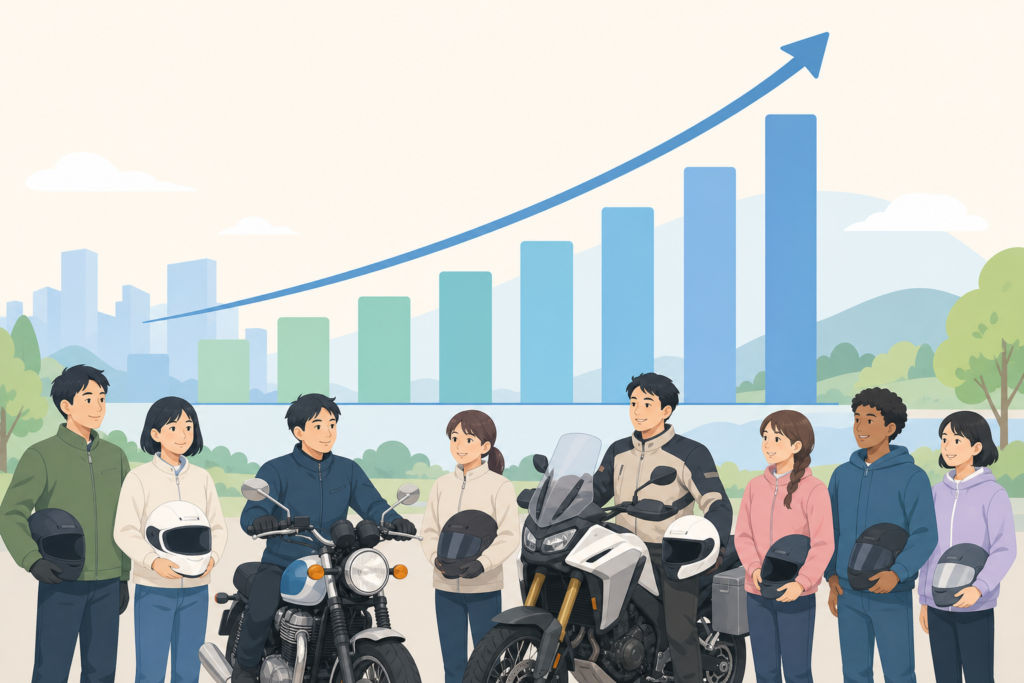
Before examining the proportion of foreign nationals, let us first look at the overall number of motorcycle license holders in Japan.
According to the 2025 Driver’s License Statistics published by the National Police Agency, the number of successful motorcycle license applicants is compiled by license category.
The number of successful motorcycle license test applicants in 2025 is as follows:
Compared to 2024, the number of successful applicants has decreased in all categories.
Therefore, it is not accurate to describe the latest situation for overall motorcycle license holders as “on the rise.” However, many people continue to obtain motorcycle licenses throughout the year.
Motorcycle licenses in Japan are categorized according to the engine displacement of the motorcycles they allow you to operate.
Large motorcycle licenses require handling heavier vehicles and advanced riding skills. For those obtaining a motorcycle license for the first time, there is also the option of obtaining a regular motorcycle license first and then progressing to a large motorcycle license.
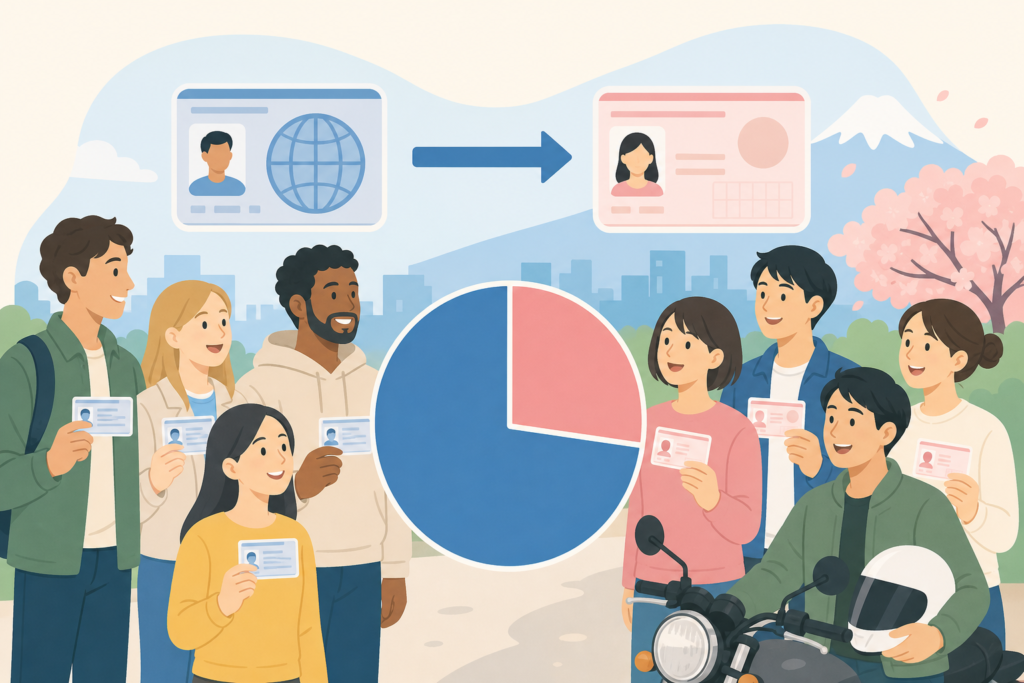
The National Police Agency statistics include the number of “foreign license conversion applicants” who converted from a foreign license to a Japanese license.
However, foreign license conversion applicants may include Japanese nationals who obtained licenses overseas. Therefore, this figure is not an exact proportion of foreign nationals and should be viewed as a reference value for understanding trends in foreign national license acquisition.
Source: https://www.sankei.com/article/20250513-ZBQTUMEMGBCBLPNFXZMVHXSJCA/
The number of people who converted from a foreign license to a motorcycle license in 2025 is as follows:
Calculating the proportion of foreign license conversion applicants among successful applicants for each license yields the following:
The proportion of foreign license conversion applicants is relatively high for small-displacement regular motorcycle licenses in particular. This may reflect demand for motorcycles with engine displacements that are convenient for daily activities such as commuting and shopping.
However, statistics alone do not allow us to confirm the purpose of acquisition or nationality, so we cannot definitively determine the background of these proportions.
Comparing the number of foreign license conversion applicants to 2024, there was a decrease in all categories in 2025.
The year-over-year growth rates are as follows:
In October 2025, address verification, knowledge assessment, and skills assessment for foreign license conversion became stricter. However, not all of the decrease is necessarily due to the policy change, so it is important not to definitively attribute the cause based solely on statistics.
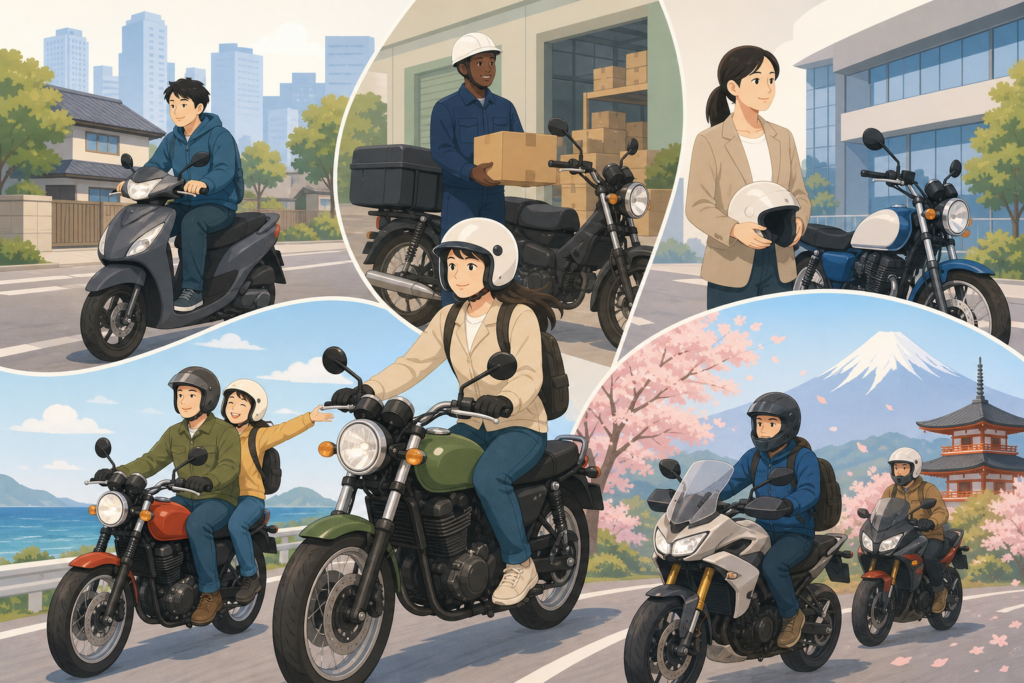
The reasons foreign nationals obtain motorcycle licenses in Japan are not limited to hobbies. In some cases, motorcycles are necessary for daily life and work.
In rural and suburban areas, the frequency of trains and buses may be low, and cars or motorcycles may be necessary.
Having a motorcycle license makes it easier to get around in situations such as the following:
Small motorcycles are relatively easy to handle and parking spaces are easier to secure, so some people consider them as a means of daily transportation.
Depending on the type of work, a motorcycle license may be a hiring condition or a job requirement.
Typical jobs include the following:
However, even if you obtain a license, the types of work you can engage in differ depending on your residence status. If you are obtaining a license for work purposes, it is advisable to confirm in advance with your employer or a specialized organization.
Japan has many tourist routes suitable for motorcycle riding, including coastal areas and mountainous regions.
By obtaining a motorcycle license, you can enjoy activities such as the following:
If you are riding a motorcycle for the first time, it is important to consider the size and ease of handling of the vehicle and start with a manageable license category.
If you have obtained a motorcycle license in a foreign country, you may be able to convert it to a Japanese license if you meet certain conditions.
However, the foreign license conversion procedures were revised on October 1, 2025, and more thorough preparation is now required than before.
The knowledge assessment for foreign license conversion was changed as follows:
There is now a more detailed assessment of whether you accurately understand Japanese traffic rules.
Older websites and videos may still explain that “passing requires 7 out of 10 questions correct,” but this differs from the current criteria.
In the skills assessment, tasks such as passing through crosswalks have been added.
The main points assessed are as follows:
Even if you have been driving in your home country for a long time, the direction of traffic and traffic rules may differ in Japan. It is important to study Japanese road signs and driving methods before the test.
From October 2025 onward, when foreign nationals apply for foreign license conversion, address verification using a residence certificate or similar document is required in principle.
Therefore, short-term visitors and tourists who do not have a residence certificate cannot apply for foreign license conversion in principle, except for diplomats and other legal exceptions.
In addition, to use foreign license conversion, you must prove that you resided in the country or region where you obtained the foreign license for a cumulative total of three months or more after obtaining the license.
There are two main methods for obtaining a motorcycle license in Japan: foreign license conversion and attending a driving school.
If you hold a motorcycle license obtained in a foreign country, you may be able to use foreign license conversion.
The general process is as follows:
Depending on the country or region, the knowledge assessment and skills assessment may be exempted. Required documents and reservation methods also differ by prefecture, so advance confirmation is necessary.
In addition, if you only hold a regular automobile license in a foreign country, you cannot obtain a large motorcycle license through foreign license conversion. In principle, you convert to a Japanese license corresponding to the vehicle type of your foreign license.
If you do not hold a foreign motorcycle license, there is the option of attending a driving school in Japan to obtain one.
The basic process is as follows:
Driving schools offer both commuter-based and residential training camp formats.
Conditions for accepting foreign nationals and supported languages differ by driving school. Before applying, confirm whether classroom instruction and teaching materials are available in foreign languages.
Japan License Connect allows foreign nationals who want to obtain a license in Japan to access information about driving schools and the licensing system.
When searching for a driving school, it is important to compare the following conditions:
Even if a school is listed as “foreign language support available,” the content varies—some may only support reception, while others may support classroom instruction and teaching materials.
Rather than deciding on a single driving school, organizing the conditions you need and comparing options will make it easier to find a driving school you can attend with confidence.
According to the 2025 National Police Agency statistics, foreign license conversion applicants numbered 870 for large motorcycle licenses, 3,790 for regular motorcycle licenses, and 3,227 for small-displacement regular motorcycle licenses.
The proportions among all successful license applicants are as follows:
On the other hand, compared to 2024, the number of foreign license conversion applicants decreased by approximately 38% in all categories.
However, the National Police Agency statistics alone do not allow us to confirm the number of motorcycle license holders limited to foreign nationals or proportions by nationality. It is important to understand that “the proportion of foreign license conversion applicants” and “the proportion of foreign nationals” are not the same.
When you are unsure about choosing a driving school, compare conditions such as supported languages, available licenses, and commuter-based or residential training camp options to find a driving school that suits you. For more detailed information on license acquisition, continue to check Japan License Connect.
 関連記事
関連記事 Feel free to contact us with any questions.
 For individuals